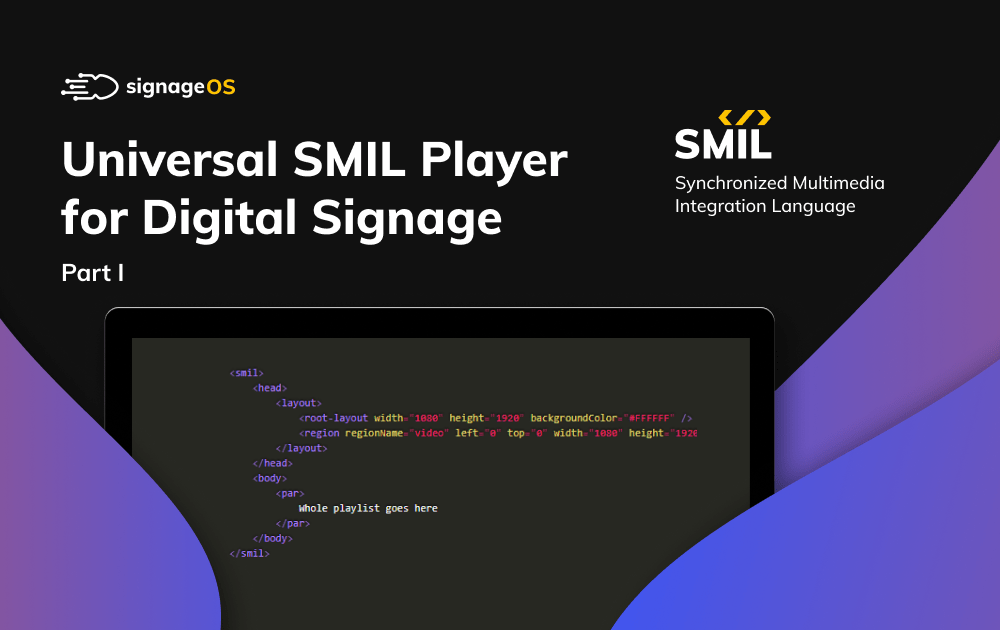
To further enable rapid app deployment to any digital signage hardware, signageOS announces the universal, open-source SMIL player application. Rapid application development and deployment to any digital signage hardware is easier than ever before through the signageOS universal SMIL player.
The signageOS universal SMIL player enables CMS companies and other digital signage stakeholders to easily develop once using SMIL, the W3C (World Wide Web Consortium) open standard, and deploy the content to any digital signage hardware in a drastically reduced time frame. Utilization of the SMIL open standard for digital signage and the signageOS universal SMIL player has the potential to save companies thousands in time and development costs.
Before we provide real-world examples of how using the universal SMIL player app can enable companies to rapidly take on new digital signage installations and win new deals, let’s first explore what SMIL is and the history of SMIL.
What is SMIL?
SMIL (Synchronized Multimedia Integration Language) is a method of scheduling multimedia content through an XML-based text file format. Digital signage is all about content, and SMIL defines content parameters like video playlists, scheduling, layout, transitions, embedded media, etc. in an XML-based text file format that is easily readable. SMIL also supports a variety of media types, like audio, video, and even HTML.
SMIL maintains many similarities and differences to HTML. An example of these differences is that SMIL was designed to carry data, whereas HTML was designed to display data. So, content written in SMIL can achieve many of the same functions as HTML, but HTML will have many aspects of the structure and design specifically defined within the HTML file.
A major benefit of using SMIL with HTML in digital signage is the interoperability that SMIL provides. If a player application is SMIL compatible, then any content that is written in SMIL is readable by that player application. If the player application is compatible with multiple device types then those compatible devices can deploy any SMIL applications. We will go into greater detail into compatibility scenarios below.
History
Digital signage leaders like IAdea, ViewSonic, Advantech, and software providers like SignageLive first offered SMIL compatible devices and player apps as early as 2008. Since that time, few companies chose to adopt the SMIL open standard for publishing content for various reasons.
Low adoption of the SMIL open standard was primarily due to the lack of SMIL support in web browsers. Additionally, early versions of SMIL did not support multiple languages like HTML, which were rapidly growing in popularity at the time. The lack of web browser support made many digital signage companies hesitant to adopt the SMIL open standard as web-based players were becoming more and more popular.
Today, major companies like Adobe, Apple, and Microsoft still maintain SMIL compatibility. Also, there is much wider support of SMIL+ additional languages; for example, SMIL + XHTML, or SMIL + JS + SVG, etc.
Ease of Use for CMS Companies
Using SMIL for digital signage presents an simplified alternative to quickly deploy custom content that can perform identically to content pushed through a native application that was written for a specific hardware type.
Previously, there were two ways to publish content on any digital signage hardware with signageOS.
- signageOS Open: CMS companies can create their custom HTML5 application, upload it to signageOS, and the core app builder builds the app for the specific hardware in use. The user then downloads the built-in core app and deploys on to the hardware, following the provisioning processes.
- Integrate the signageOS JS API and REST API into the existing CMS application. Unlike signageOS Open, this method includes the actual integration of the signageOS Platform, which offers the complete package: remote hardware management, monitoring, reporting, knowledgebase, support, etc.
Now, the third option is to deploy using the signageOS universal SMIL player. With the signageOS SMIL app, CMS companies can instantly begin deploying custom applications written in SMIL to any digital signage hardware.
SMIL App Use Case
Let’s look at a real-world example of the SMIL integration and its usage with signageOS.
A developer has a certain model of digital signage SoC display and needs to quickly deploy content to those displays. The content is a menu board with video playlists and HTML5 dynamic content.
The developer can easily publish this type of content to any digital signage, SoC display, or media player in 4 steps. Define the zones, define the content, assign the content to the zones, and publish! There is more information on this process in the second part of the SMIL blog post, Developing and Deploying with SMIL.
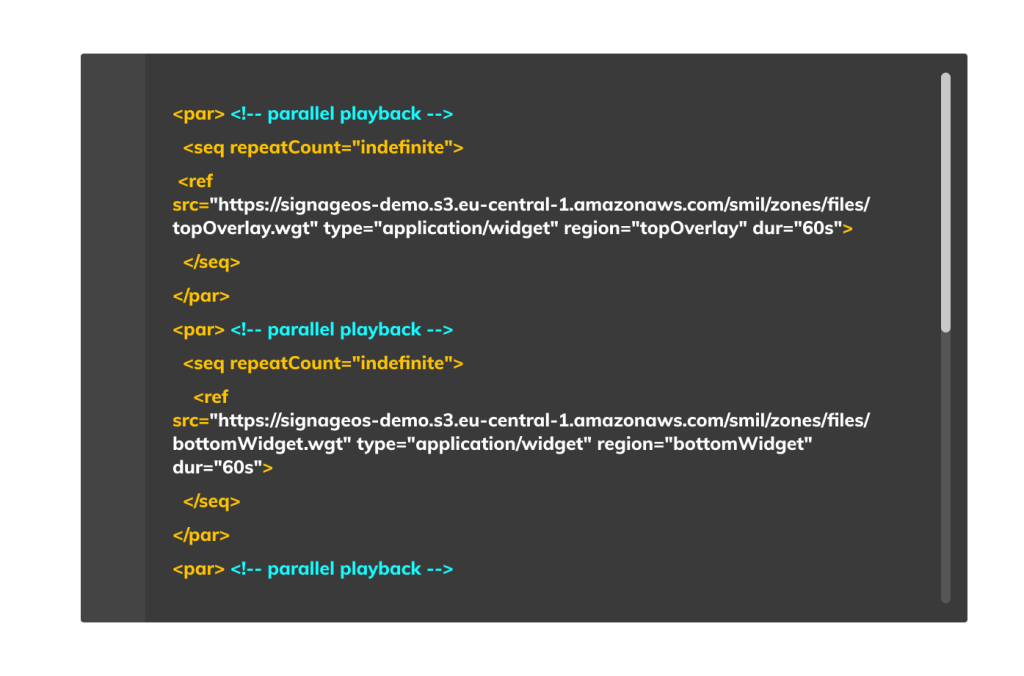
The universal SMIL player app is open source, so it can be used outside of signageOS; however, this requires additional development steps.
Once your content is defined in SMIL using the steps listed above, you can deploy through signageOS by retrieving the URL where the uploaded content is located. For example, this could be your Google Drive storage, or AWS data center, etc.
Next, install the universal SMIL player app on whichever digital signage SoC display or media player you are using. This can be completed by following the step-by-step provisioning guides in the signageOS documentation.
Once the signageOS SMIL app is installed, simply input the URL of the hosted content, and you are done! The content is published to the display or media player, functioning seamlessly as defined by the developer’s coding that was written in SMIL.
Conclusion
Utilizing the SMIL open standard and signageOS technology enables rapid cross-platform app deployment. This method of publishing content is a viable alternative that companies can still utilize, which will save tremendous amounts of time and development resources.
signageOS completes development projects such as this among many others for our digital signage partners. The development of SMIL players for every digital signage platform is just one example of how signageOS is enabling CMS companies to focus on their core products, leaving the development work to the signageOS development team of digital signage experts.
If you are interested in learning more about the application of the signageOS technology in non-traditional verticals or applications, reach out to us, and we will be more than happy to demonstrate how we are continually improving cross-platform digital signage development for our partners.


 News
News 
Leave a comment